Showing posts with label museum. Show all posts

Saturday, 9 March 2024

Caister Castle and Motor Museum

Wednesday 21 August 2002. After looking around the older parts of Great Yarmouth the sky was still a little threatening and we decided to visit Caister Castle which had a motor museum where we could spend the rest of the afternoon indoors, looking at the collection of cars.

There is little left of the castle itself. It was built in (well... "from") 1432 by Sir John Fastolfe. Born in 1378 he was ambitious, brave, educated and religious. He was a patron of the arts and universities, a statesman and a soldier with 40 years service.

It seems a shame that Shakespeare was to defame him so badly with his character of Falstaff. Fighting against Joan of Arc with extended supply lines he chose correctly to withdraw. Shakespeare depicted this as cowardice. However in real life he was awarded Governorship of Normandy for the following four years.

The tower from across the moat (previous photograph) presents almost a chocolate box image. From inside the castle (seen in this photograph) there is access to a spiral staircase that takes you up to the top of the tower where you can strike weird and wonderful poses for the cameras of your fellow tourists below. There are quite a few examples of graffiti from centuries gone by etched into the walls by daggers or coin edges.

A few vehicles are dotted about the grounds. We first came across this old London horse-drawn tram as a barely recogniseable "shed" of bare rotting wood in 1981. Ten years later it looked almost brand new. Now it was once again looking as though it needed some TLC, at least a coat of paint.

A railway platform tractor - they were used to pull trains of flat wagons for luggage. The majority of the vehicles and just about all of the cars are under cover. They are preserved rather than concours. Cleaners use dusters but not water or polish. However, the place is well worth a visit and I would not want to hazard a guess at the total value of cars on display.

Great Yarmouth 2002 Index

Monday, 4 March 2024

Norfolk and Suffolk Aviation Museum

Tuesday 20 August 2002. We left Billingford Mill and headed for our next source of interest and wonderment. Which we found at a disused World War II aerodrome, now a museum. With free entry no less.

The Norfolk and Suffolk Aviation Museum turned out to be an absolute gem. This part of England was home to many squadrons of the RAF during World War II and saw much action as the German Luftwaffe either flew over on their way to or from bombing raids, or flew intentionally to RAF bases to knock them out of commission.

There were displays of aircraft standing all around representing many different periods and many different countries' air forces.

Given that Suffolk and Norfolk were on routes used by the Axis forces to and from bombing raids and that many of our own returning fighters and bombers would be trying to get back whilst shot up and badly damaged, the surrounding countryside has more than its fair share of crash sites, some of which have been excavated. Here a pile of twisted and battered aircraft parts, laboriously dug out of the ground were stored, some awaiting appraisal and identification.

A Vickers Valetta C2 used for VIP transport with the RAF in Malta, Egypt and Cyprus. The Valetta entered service in 1950, replacing the DC3 Dakota.

This aircraft was open to visitors and I went inside to take a look. This is one of only eleven aircraft built. The C2 was a specialised VIP transport. The bulk of the RAF's Valettas were C1 variants which had been designed for a number of roles and internal configurations, including troop carrying, wounded transports and glider towing. Internal fittings were made to be easily removed and fitted as required for different roles. Production of the C1 totalled 211 aircraft.

Inside the C2, the seating was arranged to face the tail of the aircraft. Typically they could seat between 9 to 25 passengers.

Every passenger comfort catered for... Ventilation controls and outlet and a button to call the steward's attention.

More displays could be found in the museum's large buildings. Gun turrets from medium to large bomber aircraft.

Tail gunners in particular were extremely vulnerable. Squashed into tiny turrets with knees up at chest height, there wasn't much chance of making a fast getaway in case of disaster, and after several hours cramped into position, you would be very stiff, freezing cold, and grateful of any assistance to get you out and straightened up even when the plane landed without having seen enemy fighters.

There's no such thing as a junk corner in a place like this - just collections of, as yet, unidentified parts and items without context.

This Spitfire wasn't a real aircraft, but was one of the many replica props built for the filming of the 1969 movie, The Battle of Britain.

There were many glass cases filled with Airfix or Revell 1/72 scale plastic model aircraft and I could have happily stood drooling over the many kits I remembered building as a boy.

The Gloster Javelin was the world's first delta winged twin jet fighter. This example dates from 1958 and was used to support the Zambian Government against Rhodesia.

Great Yarmouth 2002 Index

Tuesday, 12 September 2023

A Free Day in Sidmouth

Tuesday 29 August 2023. We have no excursion today as it's Andrew's day off so we have a free day in Sidmouth.

We walk (slowly!) up the hill to Connaught Gardens. These were developed from a cottage garden of the 19th century and were bought and developed by the local authority following the death of the own in the 1930s. The gardens were opened by the Duke of Connaught, the third son of Queen Victoria in 1934, by which time he was in his 80s.

I sat and sketched the view from the western end of the gardens where a set of white-painted steps, known as Jacob's Ladder, reach down to the beach far below. It is a shingle beach but traces of sand can be seen just at the edge of the sea. A teenaged girl was jogging up the stairs, along past my bench and then down the cliff path to repeat her circuit. "Wow, that's really cool!" she said. And proudly I suppose it must be if I can impress teenaged girls at my age...

A few spots of rain stirred us into walking back down the hill into town. We had seen a sign for a toy museum and went to have a look. I used to have one of these Merit games as a very young boy. I know I'm bigger now but even so I was surprised at just how small it was! It worked by magnets on the end of a plastic concertina scissor contraption like a trellis attached to the bottom of the lever and a fixed point somewhere between the lever and the playfield at the bottom of the box. This meant that moving the lever would magnify the movement of the magnet.

We came out of the museum back into rain and went to look for somewhere to eat. We found a little cafe in a courtyard where we have eaten before. It had obviously changed hands as there was a distinctly Asian look to the decorations, very exotic! We had a scone with jam and clotted cream each - utterly gorgeous. By the time we came out it was fine again and we walked down to the seafront and along to the cliffs at the eastern side of the Promenade, turning in to walk along the River Sid.

The weir. The path diverted through a small park onto the streets of Sidmouth.

The Swan Inn has stood here since around 1770 and is described as a traditional back street pub.

We turned left past the pub and thus came to one of the town's main shopping streets. Unable to drink alcohol any more because of the pesky medicals, we did the next best thing and went into the Old Ship Inn, now a Costa Coffee but I can remember it being open as a public house.

It dates from the 1300s (the Blue Placque says "1400s") and has known smugglers, rowdyism, so many unwashed bodies that the street outside stank so much it was just about a no-go area and rumours of a penny hang room upstairs - a room with a rope tied taut from wall to wall over which people could hang for a penny to go to sleep - and a report that someone once tried to enter with a dancing bear which caused great consternation amongst the customers!

A newspaper report of 1859 tells of the landlord being summonsed to court after a constable had visited one night to find 30 men, women and boys in the tap room with a man playing a fiddle and "girls of bad character" and people dancing. The fiddling (I'm thinking of the chap with the fiddle but...) and dancing went on until the early hours of the morning and the landlord was summonsed to appear in court. Apparently despite all these people on the premises the poor constable could produce no evidence of complaints or witnesses and the landlord got away with a fine of just two pounds, including costs!

Coach Trip to Sidmouth, August 2023, Index

Saturday, 1 April 2023

Wookey Hole and Cheddar Gorge

Friday 23 February 1996. It's the last day of our holiday and we are heading for home today.

On the way north though, we'll stop a couple of times in Somerset. Our first stop is at Wookey Hole, where there is a large cave system that you can go through and also a fine collection of old amusement penny slot machines. The guide showing us around the caves was very funny. The fairground museum had some old roundabout or carousel carved animal figures.

The carvings included this carved but unpainted horse's head.

Then it was back to childhood with a flood of nostalgic recognition as we entered a couple of rooms filled with old penny slots. We bought a handful of big old copper pennies and lost ourselves in the 1950s and 60s, playing these machines which filled every seaside arcade before electrics started to replace mechanics.

You just can't beat a good old whirring sound and then the CHUNK-CHUNK-CHUNK as the reels of a one-armed bandit came to a stop, one after the other. The Beromat was a German-made machine and a staple of arcades for many years. And look! I won tuppence for a cherry on the first reel!

Then there were the games where an eye for the movement of the ball, a bit of skill and co-ordination, and a grasp of the Laws of Physics helped you win... or otherwise... Allwins, Payramid (featured here) and other machines where your pennies dropped and bounced off a series of pins whilst you tried to get one into a winning cup or slot.

Our pennies ran out - when was it ever any different? So we got back in the car, resigned to the fact that our holiday had come to an end. Or had it? "Come on, we'll drive down Cheddar Gorge and head that way towards the motorway."

It was deserted. And it was once again well below freezing point. We stopped - the only car in sight - and looked briefly into the cave opening but without being in the slightest bit tempted to go in to explore it. Those caves run for miles and can flood too, if water manages to stay in liquid form...

I'm not sure about inside the cave, but outside it was far too cold even for water to run down the cliff face and be able to reach the ground!

Return to England South Coast, 1996 Index Page

Saturday, 11 February 2023

Boscastle

Friday 9 August 1996. We left Tintagel and a few miles away we came to Boscastle where we had tea.

We looked in vain for the real cottage that is the inspiration for one of Fran's models. As we were in the last shop before going back to the car I found a postcard of the cottage and we were able to ask the shop owner where it was.

Boscastle is another of those never-changing fishing villages of Cornwall. The cliffs make a natural harbour, protected from the sea by a long inlet and harbour wall.

The village winds its way down alongside the River Jordan - what? Well not the one in the Holy Land perhaps but another smaller River Jordan that flows into the River Valency, seen here. There is a Museum of Witchcraft here, apart from the gift shops, perhaps the only nod to tourism. It very bizarrely contained the skeleton of a local "witch", Joan Wytte, who died in Bodmin Jail after being jailed in 1813 for brawling. She had been known for a local healer and clairvoyant and before her death aged 38 had become quite bad tempered violent, possibly due to a tooth abscess. Her body was somehow not buried and instead her skeleton became used for pranking the locals and for use in seances and eventually spent 40 years hanging on the wall of the museum. She was eventually decently buried two years after our visit, in 1998, after poltergeist activity in the museum.

We wandered down to the harbour and its boats with the neat coils tangles of rope. They young-uns must ha' been at they scrumpy agin'...

There was an aged bridge crossing the River Valency and I sat on the river bank to do this sketch. Eight years later it was totally destroyed by the great flood of 2004 and is now an elegant, though much less pleasing steel footbridge.

There was the gentle creaking and clank of a water wheel, almost hidden in shadow. The shop on the left promises books, music, crystals, candles, arcane artifacts & pictures. I do like a good arcane artifact!

Return to Cornwall Holiday 1996 Index

Monday, 22 July 2019

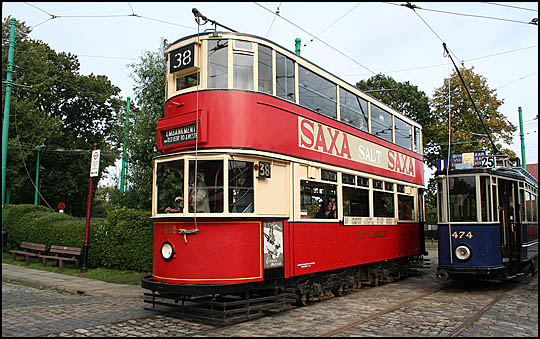
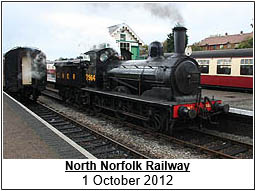
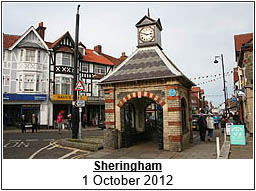
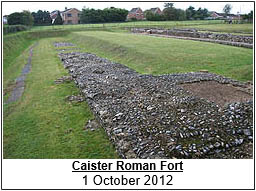
Norfolk and Transport Museums Weekend

Highlights of a long weekend break in Norfolk in 2012. We stayed in Great Yarmouth but spent much of our time visiting transport museums featuring aircraft, buses and trams, and steam trains.

Each place of interest is shown on its own separate article, reached by clicking/tapping the six photos below. A link on each page will bring you back here.

Return to Holidays in the UK Index Page

Tuesday, 27 June 2017

A Cotswolds Day

Tuesday 6 June 2017. It was once again raining as we breakfasted at the Smallbrook Cottage B&B. We were on our own today as the American guests had left to travel somewhere else on their tour.

We decided we would start at Bourton-on-the-Water, a gorgeously beautiful place with a very wide main street incorporating a green and the River Windrush which has several low humpbacked bridges crossing it. As it was raining we thought we'd start the day by having a look round the Motor Museum which can be found at one end of the main street.

We last went round it (or first went round it, which is also true) in 1998 and then it was half motor museum and half countryside museum. There is far more motoring content now and whilst some items from the countryside museum are still to be found they tend to be on the back seats of cars or displayed inside vintage caravans etc. The number of actual cars has probably doubled or trebled at a guess and I even found an example of my old beloved 1960s Ford Zephyr Mk.III which I had when I was 17.

This picnic set was on the back seat of an old car and I immediately recognised it as being the same as my grandparents had. It brought back memories of sunny afternoons up on the moors between Lancashire and Yorkshire, stopping in their old Wolseley in a lay-by and eating sandwiches that had been wrapped in waxed paper and placed in the oblong tins. Drinks were warmish tea from a Thermos flask or warmish orange cordial - Quosh - that had been diluted into an old pop bottle and got warm from being in the car. The cups and plates were Melamine, an early plastic.

We came out to a dull but dryer Bourton-on-the-Water, though it occasionally burst into showers, some of them heavy. To escape one of these we ducked into a large antiques shop which had a cafe near the back. The coffee was good, but there was that tinge of musty smell that you often get from antique shops - ancient dust and old cardboard boxes starting to disintegrate from the acid in the card or paper. I had a look in the large toy shop and wondered how young fathers ever managed to pay the asking price of a decent model railway layout, and trains these days? Fran bought a jigsaw pack with four jigsaws in it, two of Venice and two of Paris. No fault of the shop of course, but she later found that both of the Paris ones had missing pieces and had to write to the manufacturers who after checking proof of purchase apologised and sent replacement bags of the full jigsaws.

The rain was falling again and we motored down through Northleach to Cirencester. Known as the Capital of the Cotswolds, the main street is dominated by the massive three-storey porch of the parish church of St John the Baptist. It looked as though it had been recently cleaned too.

Cirencester was Corinium in roman times. There are still traces of the amphitheatre and nearby at Chedworth is the villa of a very important roman. We'll be going there in a bit.

There was an abbey here but in Henry VIII's Dissolution it was destroyed utterly apart from one Norman arch that stands alone in a corner of the Abbey Grounds. A dispute between the abbey and the townsfolk went to the very highest courts. Despite a Royal Charter from 1133 speaking of Burgesses (a freeman of a borough), the manor was granted to the abbey in 1189. The townsfolk protested immediately leading to them being amerced (fined in the modern sense - an amercement was a fixed sum imposed, whilst at the time the word fine meant that the person guilty of some sort of offence would offer an amount of his own choice). Four times in the 13th century the decision went to the abbey and against the town and in 1342 the town claimed that the Abbott had bribed burgesses in the town to surrender the Royal Charter, upon which it had been burned. The Abbott denied this and the case passed up to the King's Bench who demanded to see the foundation charter of the abbey which would have decided the case. Presumably for the townsfolk as the Abbott refused to present it, but offered to pay a fine of £300 in return for a new Royal Charter and this gave him victory at that time.

There was a bit of a ding-dong in February 1643 when Royalists and Parliamentarians had a set-to in the streets of Cirencester. 300 people were killed, but on this day, all was quiet. We went into a small cafe for some lunch and they did a home-made spiced celeriac soup. By heck, it was good, but I was tasting it for the rest of the afternoon!

Cirencester brought back memories of training courses I had been on in 1999-2001 when the firm that supplied my college's information system software was based in Cirencester. I am still in touch with a couple of people from the firm.

Driving back towards Broadway and once again in the rain we passed a sign for Chedworth roman villa, but then thought why not? and as we passed another sign I turned off. We were now driving down very narrow single track country roads with occasional passing places. At least once I had to run my nearside wheels high up a bank at the side of the road to let another oncoming vehicle pass where the passing place was not wide enough. By the time we got close to the villa we were following a coach which carried a party of Spanish schoolchildren. Car parking at the attraction was at the side of the road with cars parked diagonally into spaces. The coach was within a hand's span of them and travelling very slowly indeed!

I made sure I was tucked well into the space I found and we got out very smartish, not wanting to be behind the queue that was bound to form when the coach emptied. We paid at the desk, opted to wander about on our own and passed through into the remains of the villa. The modern building seen above is the site's museum and holds a number of artefacts.

Whilst the villa overlooks the River Coln, its water came from a convenient fresh water spring in the north west of the site and a small shrine to the water nymphs had been created here. Imagine this pool with higher walls around it, painted with a frieze of the small goddesses of the spring. The stonework seen here though is original roman and in situ.

There are bathing and plunge pools to see and some mosaics. Unfortunately rain started to fall again and we reluctantly gave up, and committed ourselves to the single-track roads again.

We stopped in Northleach to visit the mechanical music museum. We were surprised when we entered. Expecting a shop counter and a few souvenirs, we instead found ourselves in a pub! Result! There was a large party already in the museum and an hour's wait to endure. It would have seemed churlish not to sit and have a drink...

Cotswolds Holiday Index