Monday 19 August 2002. So far on this day we had been to Lowestoft and Oulton Broad, where we had lunch and we had now driven the short distance to Carlton Colville, where the East Anglia Transport Museum can be found.

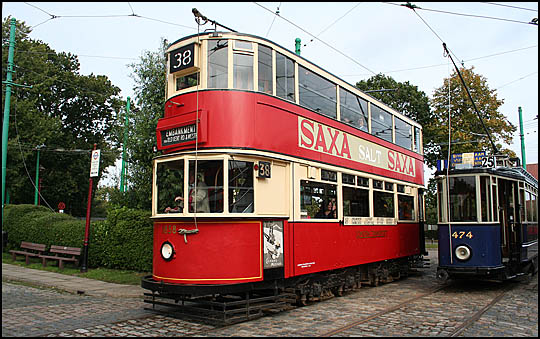
This is a working museum and usually has a couple of trams running on a road circuit. Today it was the turn of the Blackpool Standard tramcar No.159, which had been one of two such tramcars in Blackpool that had been decked with exterior lamps in a decorative design to be used during the resort's famous Illuminations every autumn. They were retired in the 1960s. In the centre is an Amsterdam tramcar, No.474 and bringing up the line of vehicles is an ex-London trolleybus, which has a road circuit of its own with a added loop, necessary in it's case because you can't drive trolley buses from the rear end...

So of course we made a dive for the good old Blackpool tram, coming as we did then from Blackpool. This model of tram had been replaced on the Blackpool Promenade route by the double-decked "Balloon" trams in the 1930s when pretty much all of Blackpool's trams, both single and double-decked were replaced. The replacements became some of the oldest public transport vehicles in continuous service and were not replaced themselves until 2012. Some of them still run as part of a Heritage Tram service along Blackpool's seafront.

Inside the Blackpool tram. Ornate lampshades, wooden decking and a row of seats backed to the windows with twin seats along the other side of the tram whose backs tilted either way so that passengers could sit facing the direction of travel whichever way the tram was being driven.

Along the ceiling ran a cable that operated the bell to request the driver to stop at the next tramstop. Whilst the tram was driven by electricity this cable was merely attached to a lever which dinged the bell at the back of the driver's cockpit - at either end of the tram!

Blackpool Standard 159 on the road circuit. This model of tramcar was built between 1923-1929. In Blackpool they were regularly used on the routes inland, known as the Marton route named for a district of Blackpool.

As the tram returned to its starting point we hopped off and straight onto the Dutch tram from Amsterdam. This had required a bit of work to convert it to be able to be driven from either end. Routes in Amsterdam have terminus loops allowing the tramcars to turn to face the other way whilst always being driven from the same end and in keeping with most UK tram systems, the one at Carlton Colville required the tramcar to swivel the pole round on the overhead wire and be driven from the "rear" end.

The Amsterdam tram had some sideways seating and also plain wooden single seats arranged to face each other along the central part of the tram cabin. Straps allowed taller standing passengers to remain upright during hard braking or sharp bends whilst children and short people could practice their rolling landing techniques...

There was also a little narrow-gauge railiway that you could ride on, drawn by a diesel locomotive seemingly built by some engineer who hated beauty in all its forms... Possibly it started life working deep underground in a mine or something.

There were a few sheds, packed with nostalgic items dimly remembered from my youth. Like this Flit spray. Before the days of aerosols this is how you sprayed those pesky bugs. With a hand pump. Flit was made by Esso which made me wonder could you just give a decent squirt in the general direction of a bug and then strike a match to scorch the thing at a distance?

In another shed I found a small collection of electric battery-driven milk floats. We still have one that comes down our road once a week. It sometimes goes downhill so slowly we wonder whether it will make it back up and we don't live on any steep gradient. I remember as a lad it was a regular sight to see one being pulled back to the depot by a horse or in later years, a van.

Not that they were ever designed to go like the clappers... In the 1950s milk came in glass bottles and 24 bottles came in metal crates so they had to carry a fair bit of weight. Batteries were a lot less efficient then and themselves added a fair bit of weight. Controls were minimal. Steering wheel and two pedals - one for forwards and one for reverse with another pedal or a lever to set a parking brake.

The London trolleybus. I can just about remember going on trolleybuses in Manchester, though it would only be as a special treat, as buses between home and Manchester were ordinary diesel engined buses. The quiet due to lack of engine noise was strange but the best part about seeing them was waiting for sparks as they passed under the supports holding the twin wires up.